
Does more metal really mean more premium?
When developing a premium dog harness, one request comes up surprisingly often:
“Can we make all the hardware metal?”
We understand why.
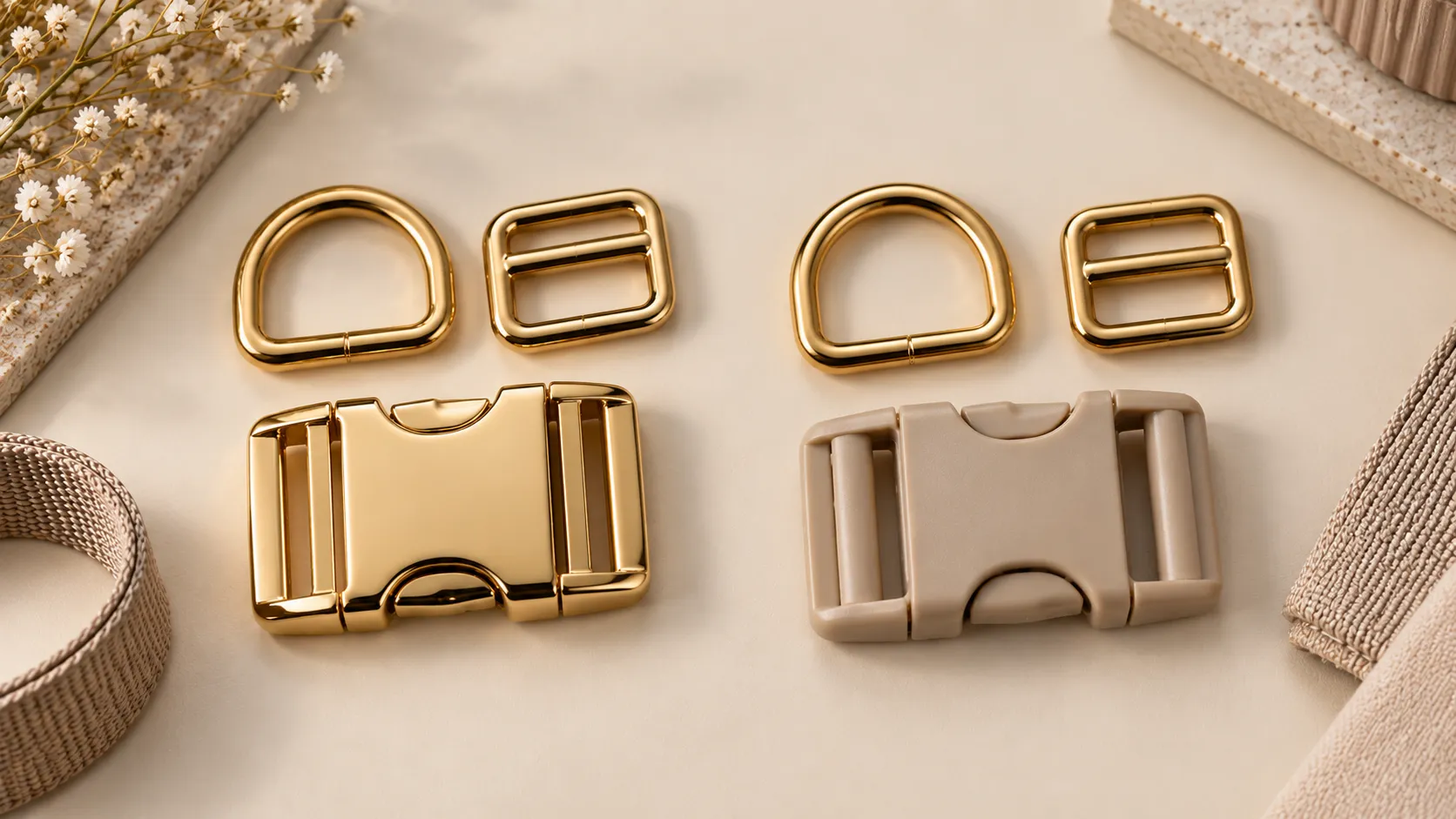
Matte gold, rose gold, gunmetal or matte black hardware can immediately make a harness look more refined. Metal D-rings, adjusters and buckles photograph beautifully, feel substantial in the hand, and can help create the luxury look many pet brands want.
But after working on different custom harness projects, we’ve learned that there is another question worth asking:
Does more metal actually make a better dog harness?
Not always.
Sometimes, the best solution is not choosing between metal or plastic. It is knowing where metal adds value, and where it may simply add unnecessary weight.
1. Why Do Pet Brands Love Metal Hardware?
For a new pet brand, hardware is one of the easiest ways to change the overall feeling of a product.
Imagine the same beige harness in two versions.
One uses standard black plastic hardware. The other uses polished gold D-rings, matching adjusters and a small metal logo plate.
Even before touching the product, the second version may feel more premium.
That is why we often receive requests for:
- Gold or rose gold D-rings
- Metal strap adjusters
- Metal quick-release buckles
- Custom metal logo plates
- Matching metal leash clips
There is nothing wrong with this direction. For some collections, metal hardware is exactly what gives the product its identity.
The issue begins when every piece of hardware becomes metal simply because metal is considered “more premium.”
A harness is not only something customers see on a website. It is something a dog may wear for an hour or more during a walk.
That changes how we think about the design.
2. The Hidden Problem: Hardware Weight Adds Up Quickly
A single metal buckle may not feel particularly heavy when you hold it in your hand.
Neither does one D-ring.
Neither does one adjuster.
But a dog harness may have several pieces of hardware:
- One or two leash attachment D-rings
- Two or more strap adjusters
- One, two or even three buckles
- A metal logo plate
- Additional rings or connection points depending on the design
Individually, each component seems reasonable.
Together, they can noticeably increase the weight of the finished harness.
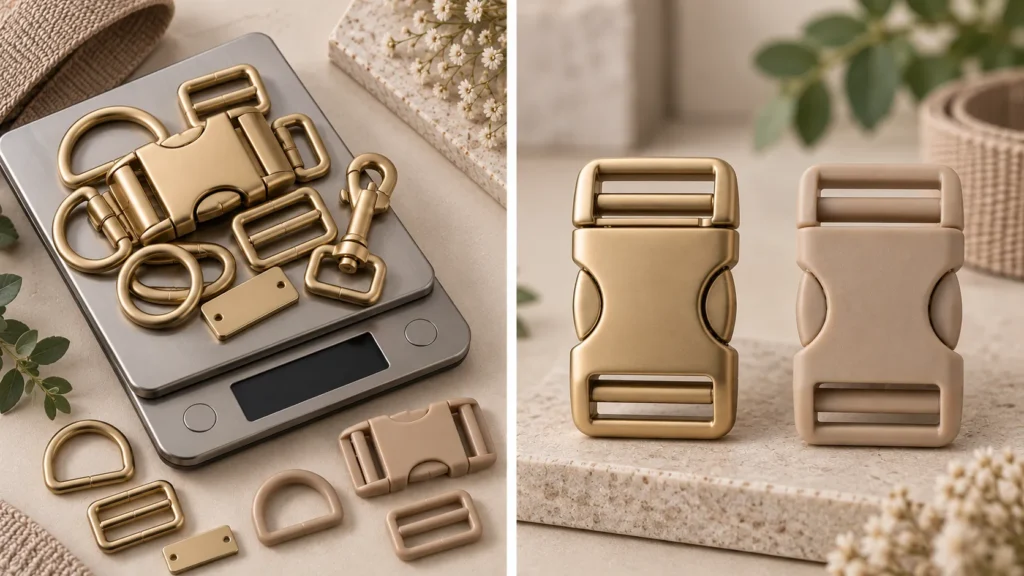
Metal hardware can create a premium look, but the combined weight of multiple components is worth considering during harness development.
This becomes especially important when developing harnesses for small dogs.
A metal buckle that feels insignificant to us can represent a much larger proportion of the total harness weight on an XS or S size.
That is why we prefer to look at the finished harness as a complete product, rather than evaluating every hardware component separately.
The smaller the harness, the more carefully hardware weight should be considered.
3. Your Customer Can Tell You the Harness Is Heavy. Their Dog Can’t.
This is something we often think about when developing pet products.
If we buy a jacket and it feels too heavy, we can take it off.
If we carry a backpack with unnecessary metal parts and it becomes uncomfortable after 30 minutes, we know exactly what is bothering us.
A dog cannot explain that in the same way.
Of course, this does not mean that a metal buckle automatically makes a harness uncomfortable. But think about it from our own experience.
A few extra metal parts may not feel heavy when we first put on a jacket or backpack. But after wearing it for an hour-long walk, we may start wondering whether all that extra weight is really necessary.
Dogs cannot give us that feedback in words. So when we develop a harness, we think it is worth asking the same question on their behalf.
4. A Real Example From a Custom Harness Project
We recently discussed this with a customer developing a luxury-style dog harness. The original idea was to use metal for almost every hardware component because the brand wanted the product to feel elegant and premium.
Visually, we completely understood the direction. But when reviewing the construction, our concern was the total weight once the metal D-rings, adjusters, buckles and logo plate were all added together.
Instead of removing the premium metal details completely, we suggested a more balanced option: keep the metal D-rings and adjusters, but change the quick-release buckle to a color-matched plastic buckle.
This way, the harness can still keep the elegant metal details that are important to the brand, while reducing some unnecessary weight.
5. Are Plastic Buckles “Cheap”?
This is probably the biggest concern brands have when we suggest changing a metal buckle to plastic.
And the answer is:
Not necessarily.
When we suggest a plastic buckle, we are not talking about simply choosing the cheapest plastic option available. There is a big difference between a thin, low-quality plastic buckle and a well-made POM (acetal) buckle designed for pet products.
For us, changing from metal to plastic is not simply about reducing cost. It is about finding a better balance between appearance, weight and everyday use.
For example, a good-quality color-matched POM buckle can blend naturally into the harness design while helping reduce the overall weight. At the same time, you can still keep metal D-rings, adjusters or a logo plate to maintain the premium look of the product.
They are lightweight.
This is the most obvious benefit, especially when several buckles are used on one harness.
They can match the harness color.
A plastic buckle does not always have to be black. Depending on the project and quantity, color-matched buckles can blend naturally into the overall design.
There is no plated metal surface to worry about.
With plated metal hardware, the finish itself becomes part of the quality evaluation. Scratching, friction and long-term surface appearance should all be considered.
They can create a cleaner visual design.
Sometimes a buckle that disappears into the fabric color actually makes the metal D-ring or logo stand out more.
This is why we don’t automatically see plastic hardware as the “cheap option.”
The quality depends on the material, buckle construction, supplier and intended application.
And just as importantly, we would never assume that a component is strong enough simply because it is metal—or weak simply because it is plastic. Load-bearing components should be selected and tested according to the actual harness construction and intended use.
6. Our Preferred Approach: Use Metal Where It Matters
When a customer wants a premium-looking harness but we feel the complete metal setup may become too heavy, we often recommend a hybrid hardware design.
For example:
Metal D-ring + metal adjusters + color-matched POM buckle
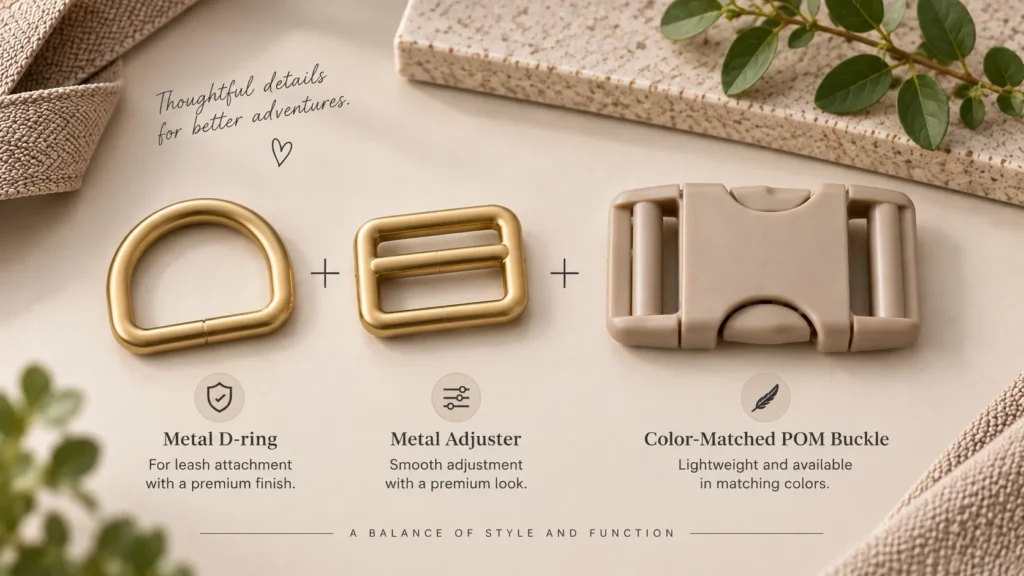
This keeps the parts that contribute strongly to the premium appearance in metal, while replacing one of the heavier components with a lighter alternative.
The result can still look elegant.
Imagine a sage green harness with gold D-rings and gold adjusters, but a sage green buckle that blends into the body of the harness.
Or a beige harness with a gold logo plate and D-ring, combined with a beige quick-release buckle.
The product doesn’t suddenly look “cheap” because one component is plastic.
In some cases, it can actually look cleaner and more considered.
Premium design doesn’t mean putting metal everywhere. Sometimes, knowing where not to use metal is part of good product design.
7. Metal vs. Plastic Dog Harness Buckles: A Quick Comparison
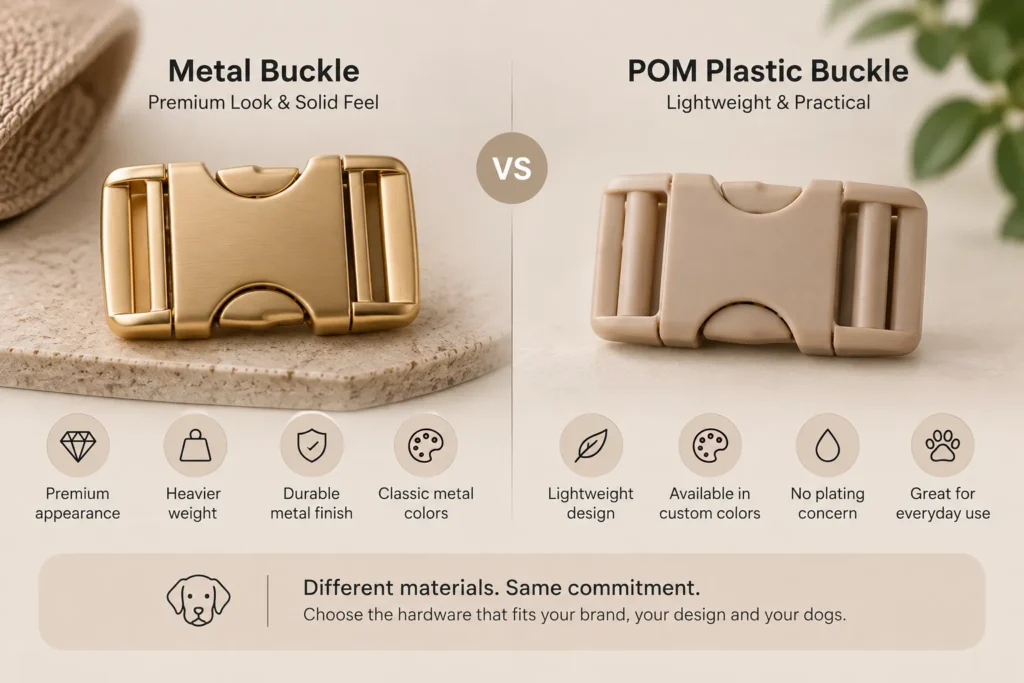
| Consideration | Metal Buckle | Quality Plastic/POM Buckle |
|---|---|---|
| Premium appearance | Excellent | Depends on design and finish |
| Weight | Generally heavier | Generally lighter |
| Color matching | Usually based on available/plated finishes | More flexible for matching product colors |
| Luxury feel | Strong | More understated |
| Surface finish | Plating/finish should be evaluated | No metal plating |
| Small-dog harnesses | Weight needs closer consideration | Often useful for reducing total weight |
| Best use | Luxury/fashion designs where the weight works | Lightweight/everyday designs or hybrid constructions |
For load-bearing hardware, we recommend evaluating the actual component together with the harness construction rather than choosing by appearance or material name alone.
This table is only a general design reference.
The exact result depends heavily on the specific buckle. A lightweight metal component and a heavy plastic component can obviously change the comparison, and strength should never be judged by material alone.
For OEM development, the actual component and finished sample matter more than the label “metal” or “plastic.”
8. Does That Mean We Never Recommend an All-Metal Dog Harness?
No.
There are definitely projects where all-metal hardware makes sense.
For example, a luxury fashion collection may intentionally prioritize the substantial feeling of metal hardware. A larger harness may also handle the additional hardware weight differently from a very small harness.
And sometimes a brand simply has a very clear design language: they want gold metal hardware throughout the collection, and that visual consistency is important to their positioning.
In those situations, we are happy to develop the product in that direction.
We just recommend checking one thing before making the final decision:
Don’t judge the hardware only from a photo or hardware sample. Judge the finished harness.
Once the fabric, padding, webbing, logo and all hardware are assembled together, you can properly understand how the product feels in the hand—and more importantly, how it feels when worn.
9. What Should Pet Brands Check During Sampling?
This is exactly why we believe the sampling stage is so important.
When developing a custom dog harness, don’t only check whether the Pantone color is correct or whether the logo is positioned perfectly.
Pick up the finished harness.
Feel its weight.
Open and close the buckle repeatedly.
Move the adjusters.
Attach a leash to the D-ring.
Put the harness on a dog within the intended size range and observe how it sits and moves during a normal walk.
If you’re unsure about metal versus plastic hardware, it can also be useful to compare the two constructions before committing to bulk production.
Sometimes a beautiful metal buckle feels completely fine on the finished product.
Sometimes you hold the sample and immediately think:
“This is heavier than I expected.”
That is exactly what samples are for.
Finding that out before production is much better than finding it out after hundreds of harnesses have already been made.
10. Think About the Finished Harness, Not Just the Hardware
A brand may choose its favorite buckle, then its favorite D-ring, then the nicest adjuster, and finally a metal logo plate. Each choice looks good by itself. But once they are all placed on one harness, the overall result can feel very different.
That’s why we prefer to evaluate the finished harness rather than each hardware component separately.
If the metal D-rings and adjusters already give the product the premium look you want, does the buckle really need to be metal too?
Sometimes yes. Sometimes no.
That is exactly what the sampling stage is there to help you decide.
11. Premium Should Be Something the Dog Can Wear, Not Just Something the Customer Can See
We understand why pet brands are attracted to metal hardware.
We like it too.
A beautiful gold D-ring, a clean metal adjuster or a custom logo plate can completely change the personality of a harness.
But after a product moves from a rendering to a real sample, appearance is only part of the story.
There is also weight, fit, movement, durability and everyday usability to consider.
For many custom dog harness projects, the best answer is therefore not:
Metal or plastic?
It is:
Where should we use metal, and where don’t we need it?
Our usual approach is simple: keep metal where it adds functional or visual value, and consider lighter alternatives where additional metal mainly adds weight.
A combination such as metal D-rings + metal adjusters + a color-matched POM buckle can still create a refined, premium product while keeping the overall harness more balanced.
Because ultimately, a premium dog harness should not only look elegant in a product photo.
It should still make sense when a dog actually wears it.
12. Not Sure Which Hardware Combination Is Right for Your Harness?
If you’re developing a custom dog harness, you don’t necessarily need to decide between “all metal” and “all plastic” before sampling.
We can review your harness structure, intended dog sizes and brand style first, then suggest a hardware combination that makes sense for your product.
In many cases, seeing and handling the finished sample makes the decision much easier.